
Benefits of Hybrid Events: Why the Format Can Be Powerful
Hybrid events are not automatically better than virtual or in-person events. In fact, they're often the most demanding format to deliver well, involving more moving parts, more technology and more opportunities for something to go wrong. That's why organisations shouldn't choose hybrid because it sounds impressive. They should choose it because it's the right format for the outcome they're trying to achieve.
Understanding what a hybrid event helps explain why. Hybrid combines the energy and presence of an in-person audience with the reach and accessibility of a virtual one. When those two experiences are properly integrated, the result can be something neither format achieves on its own. For organisations weighing up the options, comparing hybrid event vs virtual event can also help clarify which format best suits the outcome they're trying to achieve.
The important point is that the benefits of hybrid events aren't created by the technology itself. They're created by what the technology makes possible. A leadership team can stand in front of employees in the room while colleagues across different offices ask questions live. A conference can welcome delegates from around the world without losing the atmosphere of a physical venue. An organisation can make remote employees feel genuinely included rather than simply watching from the sidelines.
When those things are handled well, hybrid becomes much more than a technical choice. It becomes a communication choice.
1. Connecting Physical and Remote Teams in a Meaningful Way
In many organisations, there is a quiet imbalance between people attending an event in person and those joining remotely. Leadership speaks from a room full of colleagues while everyone else watches from another office or from home. Nobody sets out to create that experience, but it's surprisingly common.
The difference goes beyond simply being in the room. People attending in person chat before the event begins, react together during the presentation and continue conversations afterwards. Remote attendees often join a few minutes before the start, watch the session and then leave as soon as it finishes. They're receiving the same information, but not the same experience.
A well-designed hybrid event closes that gap. Remote participants aren't just watching a feed; they're part of the event itself. Their questions are heard clearly, their faces appear on the screens in the room and their contributions become part of the discussion rather than an afterthought. People stop feeling like they're watching somebody else's event and start feeling like they're participating in their own.
That changes how the message lands. Communication becomes something shared rather than something being broadcast from one location to another. For organisations with multiple offices, international teams or hybrid working arrangements, that sense of inclusion isn't simply a nice extra. It's often one of the main reasons for choosing a hybrid format in the first place. One of the genuine benefits of hybrid events is that people, wherever they're joining from, feel part of the same moment rather than secondary to it.
2. Leadership Visibility at Scale
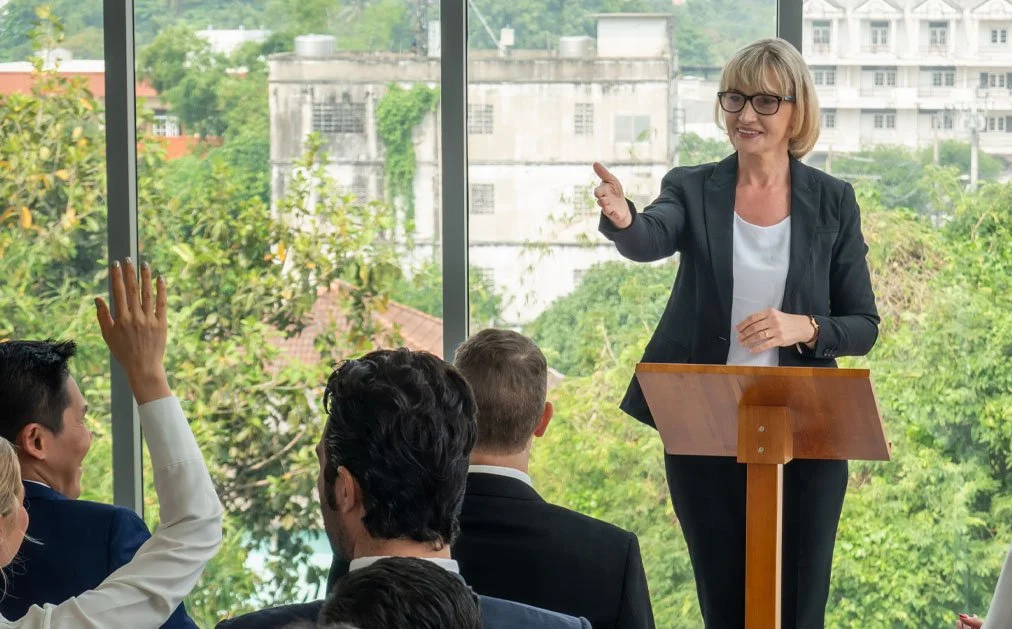
Hybrid allows senior leaders to address a physical audience while engaging teams globally at the same time. A chief executive can speak from a stage and take live questions from multiple countries, with everyone hearing the same message and the same answers in real time. That consistency builds trust, reduces misinterpretation and removes the delay between announcement and clarification.
There's also something powerful about seeing senior leaders speaking live rather than reading a summary afterwards. Questions can be answered immediately, context isn't lost and people feel like they're hearing directly from the people making the decisions rather than through layers of communication.
When delivered through structured hybrid event production services, the experience feels controlled and intentional rather than improvised. That's particularly important during organisational change, leadership announcements or strategy updates, where confidence in the delivery can be almost as important as the message itself.
3. Preserving the Energy of a Physical Event
There is still something powerful about people experiencing important moments together. Applause carries weight. Silence carries weight. Shared laughter carries weight. That's one of the reasons organisations haven't abandoned in-person events altogether. Some moments simply feel different when people experience them collectively rather than individually.
One of the biggest benefits of hybrid events is that they allow you to extend that atmosphere beyond the venue itself. The online audience sees a real environment rather than a blank background, while the in-room audience hears voices and questions from colleagues joining elsewhere. When someone from another office contributes to the discussion, it reinforces that everyone is part of the same occasion rather than separate audiences having separate experiences.
That's a difficult balance to achieve, which is why production matters so much. It's not enough for both audiences to see and hear the event. Both audiences need to feel included in it. That's often the difference between a hybrid event that feels memorable and one that simply feels like a live stream with people sitting in a conference room.
4. Extending Reach Without Losing Structure
Another of the practical benefits of hybrid events is the ability to widen participation without losing control. Not everyone can travel, not every office can justify bringing large teams together in one location and not every speaker is available to fly across the country for a one-hour presentation. Hybrid removes many of those barriers without necessarily reducing the quality of the experience.
The important thing is that expanding the audience doesn't have to dilute the experience. However, that only happens when the integration is deliberate. Hybrid is not simply a live stream with chat enabled. The distinction becomes much clearer when comparing hybrid event vs live stream. It requires managed audio, coordinated visuals, clear direction and careful planning so that both audiences experience the same event rather than two different versions of it.
That's where experience makes the difference. The technology already exists. The challenge is bringing all of those moving parts together so naturally that the audience never has to think about them. This is where experienced hybrid event production becomes invaluable.

5. Creating Shared Moments Across Geography
Information can be sent in an email. Alignment cannot.
That's one of the reasons organisations continue to invest in hybrid events. When people experience an important announcement together, they don't just receive the same information—they share the same moment. That matters more than many organisations realise.
People often remember where they were when a significant announcement was made. They remember colleagues from other offices asking questions live, seeing familiar faces appear on the screen and feeling part of something bigger than their own location. Those shared experiences help build culture in a way that documents, recordings and follow-up emails rarely can.
It's one of the less measurable benefits of hybrid events, but often one of the most valuable. You may not see it immediately in a report, but it's usually reflected in the conversations people have afterwards and in the stronger sense of connection the event creates across the organisation.
6. Reducing Risk Through Structure
Hybrid events involve more moving parts than either a purely virtual or purely in-person event. There are two audiences to think about, multiple sources of audio, remote contributors, presentation content and a live event that has to keep moving regardless of what happens behind the scenes. That doesn't make hybrid the wrong choice. It simply means preparation becomes much more important.
When content is gathered early, speakers are properly briefed and the event has been thoroughly rehearsed, the audience never sees the complexity. They simply experience something that feels calm, well organised and professional. The opposite is also true. Small issues that would barely be noticed in another format can become much more obvious during a hybrid event. A remote speaker joining late, questions from the room that can't be heard online or an awkward pause while presentations are switched all chip away at the audience's confidence.
The challenge isn't making sure nothing unexpected happens. Live events are unpredictable by nature. The challenge is making sure those unexpected moments don't become the audience's lasting memory of the event. That's why experienced planning matters so much. Good hybrid production is rarely about dramatic interventions. It's about quietly keeping everything on track so the audience stays focused on the message rather than the mechanics.
When that happens, organisers are often left with the same feeling afterwards: relief. Not because they got away with something, but because the event delivered exactly what it was supposed to without the audience ever seeing the work that made it possible.
What Should Guide the Decision?
The starting point should never be the technology. It should be the outcome.
Before choosing any event format, ask a simple question: What do you want your audience to think, feel and do by the time the event finishes? The answer will usually tell you far more than a comparison of platforms or production features ever could.
If your priority is simply broadcasting information, a live stream may be all you need. If your goal is bringing together people in different locations while giving everyone the opportunity to participate, a hybrid event may be the better choice.
For many organisations, the real decision isn't between online and in-person. It's deciding whether the occasion is important enough to justify creating one shared experience for two different audiences. That's often where the conversation becomes hybrid event vs virtual event rather than simply online versus in-person.
Hybrid events do require more planning, more coordination and more investment. But they also create opportunities that neither format can achieve on its own. They allow the atmosphere of a live venue to be shared with people joining remotely, while giving those remote participants a genuine voice in the event rather than asking them to simply watch from the sidelines.
Ultimately, the format should reflect the importance of the message, not habit. The best organisations don't choose hybrid because it's fashionable or because the technology exists. They choose it because it's the most effective way to achieve the outcome they're looking for.
Conclusion
So, what are the benefits of hybrid events?
The obvious answers are wider reach, greater flexibility and the ability to connect people in different locations. But those are really just the practical advantages.
The real value of hybrid events is that they allow organisations to create one shared experience for two different audiences. When they're planned well, people in the room and people joining remotely feel equally involved, equally informed and equally valued. That's not easy to achieve. It requires thoughtful planning, careful integration and a production team that understands how every decision affects both audiences at the same time.
When that happens, the technology fades into the background and the communication takes centre stage. Most people won't remember the cameras, the microphones or the platform. They'll remember how the event made them feel. If people felt included, understood the message and came away with confidence in the organisation behind the event, the technology has done its job.
Ultimately, the best hybrid events aren't remembered because they used lots of technology. They're remembered because everyone, wherever they joined from, felt like they were genuinely part of the same event.
If you’re responsible for delivering a hybrid event and would like to talk it through, you can book a call here and I’ll happily chat it through with you.